Clayton
A former U.S. Canal Zone community turned leafy residential district — single-family houses, mature trees, international schools, and a pace that feels nothing like the rest of Panama City.
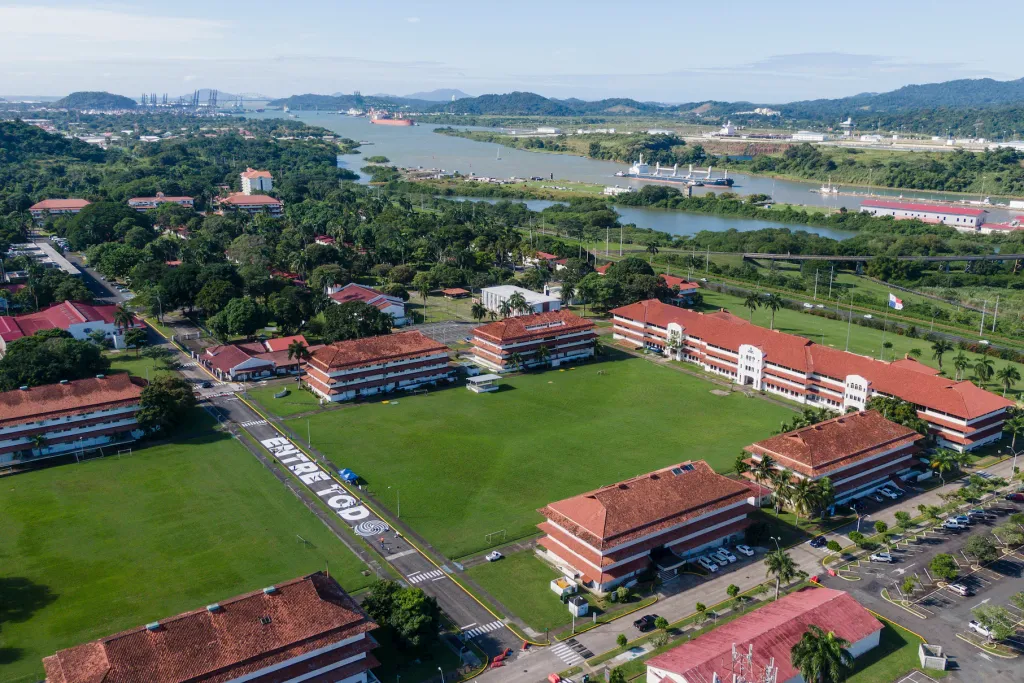
Clayton is the neighborhood our clients most often choose when what they really want is a house — not an apartment — with a garden, a carport, mature trees overhead, and an international school their children can walk to. It is the closest thing Panama City has to a leafy suburban village inside the urban footprint, and it comes with a specific history that shapes its character.
What it is
Clayton was originally Fort Clayton, a U.S. Army base operational from 1922 through the Canal handover at the end of 1999. When the Zone was turned over to Panama, the military housing stock was gradually repurposed into civilian use: some of the former officers' residences became private homes, others were converted into schools and institutional buildings, and new single-family and low-rise residential development was added around the edges over the following two decades. The urban form that resulted — long, straight residential streets lined with single-story houses, generous setbacks, deep gardens, wide pavements, and mature rain trees — is visible in very few other neighborhoods of Panama City.
Who lives here
Clayton's residents include a high concentration of diplomatic families (several embassies direct their staff to Clayton), international school families, senior professionals at multinational companies, Panamanian professional families who specifically want a house rather than an apartment, and a meaningful community of former Canal Zone residents and their descendants. It is more international per capita than almost anywhere else in Panama City.
- Families with school-age children attending the International School of Panama, Metropolitan School of Panama, or one of the other schools that cluster nearby.
- Diplomatic and NGO families on multi-year postings who want a house with a garden for their tenure in Panama.
- Professionals in their late thirties to fifties who have outgrown apartment life and want outdoor space for children, pets, and entertaining.
Clayton appeals less strongly to clients who want high-rise waterfront views, walking-distance healthcare, or a dense urban environment. It is also a meaningful car commute from the financial district, which matters for dual-career households.
Housing
The housing stock is dominated by single-family homes. Three- and four-bedroom houses typically rent between US$2,500 and US$5,500 per month depending on size, condition, garden, and whether the home is a repurposed former military house or a newer build. Larger executive residences, particularly in the newer sub-developments, can rent above US$7,000. Purchase is also a meaningful market here; inventory is thinner than in Costa del Este and Punta Pacífica but the resale market is active.
A practical note on the houses themselves: many of the repurposed former military buildings are single-story, built on raised footings, with generous square footage and deep gardens. They have character and charm but also their age — plumbing, electrical, and roof work are common early expenditures, which is where our remodelation practice most often engages in this neighborhood. Newer custom builds in the adjacent developments are turn-key but trade the distinctive Clayton character for more conventional finishes.
Daily life
Daily life in Clayton is suburban in the best sense. Children walk or cycle to school. Adults walk dogs at dawn under mature trees. There is a small commercial strip around Albrook with supermarkets, cafés, and everyday retail, and a larger shopping mall (Albrook Mall, one of the largest in Latin America) is a five-minute drive away. Full-service grocery shopping happens at Riba Smith or Super 99. Restaurant density within Clayton itself is modest; for dinner out, most residents drive to Casco Viejo, Obarrio, or San Francisco.
The area benefits from proximity to the Parque Natural Metropolitano — a genuine rainforest inside the city with walking trails, wildlife, and Pacific views — and to the Canal itself at the Miraflores Locks, a ten-minute drive away. For families with children, the combination of schools within walking distance, safe streets, outdoor space, and nearby nature is the reason Clayton works as well as it does.
Healthcare access
This is the honest trade-off. Clayton is twenty to thirty minutes by car from Hospital Punta Pacífica and Pacífica Salud, depending on traffic. In an emergency it is further than Costa del Este, Punta Pacífica, or Obarrio, and clients who prioritize healthcare proximity will not choose Clayton for that reason. That said, several of our Clayton-based clients have built their primary care relationships around The Panama Clinic in San Francisco, which is roughly twenty minutes away, and have kept specialist relationships at Hospital Punta Pacífica for annual checkups. For families with children and no ongoing specialist needs, the distance is manageable. For older clients with active cardiac, oncology, or orthopedic issues, we usually recommend Costa del Este or Punta Pacífica instead.
What we'd also tell you over coffee
Clayton trades urban convenience for space, trees, and a slower pace. It is the neighborhood families most often wish they had known about sooner.
The clients who land in Clayton almost always arrive there after looking at Costa del Este first. They see Costa del Este, appreciate it, and then visit Clayton and realize they want a garden more than they want a tower. Once that preference is visible, the rest of the decision moves quickly.
The two honest caveats are the commute — traffic on the Corredor Norte or the Avenida Omar Torrijos at rush hour can be punishing — and the healthcare distance discussed above. The compensating benefits are a quality of family life that is difficult to reproduce in apartment Panama, a stronger sense of community than the newer districts, and schools and green space that are genuinely within walking distance.
A realistic first week
For a family landing in Clayton: house handover and initial walk-through on day one; school orientation within the first three days; first trip to Albrook Mall or the Riba Smith in Albrook for initial setup; a walk in Parque Natural Metropolitano for the family; first dinner either at home or in one of the cafés near the mall. Utility and internet connection can take one to two weeks to settle into a single-family house compared with an apartment tower, and we manage this for clients as part of the soft landing. Children usually adjust to the walk-to-school rhythm within the first two weeks.
Is Clayton right for you?
Clayton is the right call if you want a house with a garden, children walking to school, mature trees, a low-density residential pace, and a more internationally flavored neighborhood than the new developments. It is the wrong call if you want walking-distance healthcare, a waterfront view, or a short commute to the financial district. For families on a multi-year posting in Panama, and for clients who specifically want outdoor space as part of daily life, Clayton is often the eventual right answer.
Further reading
- International School of Panama — official site: isp.edu.pa
- Metropolitan School of Panama: metropolitanschoolpanama.com
- Parque Natural Metropolitano: parquemetropolitano.org