Costa del Este
A planned district, built east of the old city — modern, quiet, and, for most of our professional and family clients, the most comfortable landing place in Panama.
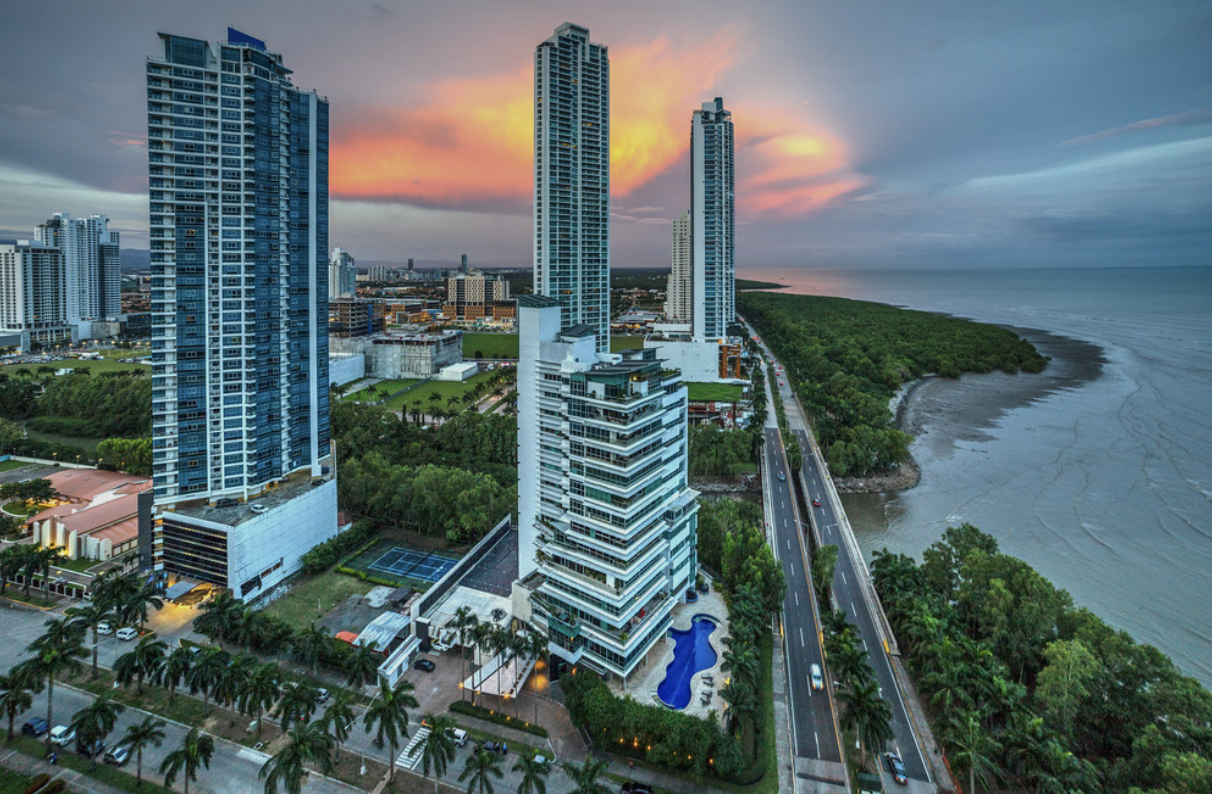
Costa del Este is the neighborhood we send most professional and family clients to first — not because it is automatically the right answer, but because it tends to be a useful benchmark. If you walk Costa del Este on a weekday morning and a Saturday afternoon, you will understand Panama City's middle-to-upper-middle-class residential life quickly. Every other neighborhood on our list makes more sense once you have that baseline.
What it is
Costa del Este is a planned district developed on reclaimed and former industrial land east of the older city, beginning in the late 1990s. Because the area was master-planned, it has something most of Panama City doesn't: wide, predictable streets, generous green spaces, and a coherent mix of residential towers, low-rise apartments, single-family homes, and commercial blocks.
The residents are a mix of Panamanian professionals and international families. A sizeable share work in the corporate park on the district's northern edge, which hosts the regional headquarters of a number of multinationals. Others commute into downtown, a fifteen- to twenty-minute drive depending on traffic.
Who lives here
In our experience, Costa del Este appeals strongly to three types of clients:
- Dual-career families where both partners want a short commute and a modern apartment rather than the maintenance burden of a house.
- Families with primary-school-age children attending the International School of Panama (ISP) in nearby Cerro Viento or the Oxford International School within Costa del Este itself.
- Professionals in their forties and fifties who want a quiet residential base that is close enough to downtown for evenings out but far enough to leave the city's congestion behind.
It appeals less strongly to retirees who want healthcare within walking distance (Punta Pacífica tends to win there), and to clients who specifically want a walkable, dense, old-city feel (Obarrio or Casco Viejo tend to win there).
Housing
Costa del Este is predominantly a rental market in the high-end segment. Most of the residential stock is modern apartments (two to four bedrooms) in towers with concierge, gym, and pool. Single-family homes exist within small gated enclaves — Santa María, for example — at significantly higher price points.
Indicative rents as of 2026, for well-finished apartments in reputable buildings, run approximately:
- 2-bedroom, 130–150 m²: $1,600–$2,400 / month
- 3-bedroom, 180–220 m²: $2,200–$3,800 / month
- 4-bedroom or penthouse, 250 m²+: $3,800–$6,500 / month
- Houses in Santa María: $5,000–$12,000+ / month
These ranges are indicative and shift with building quality, view, and the specifics of furnishing. We always verify against live listings before any client visit.
Schools
For families, Costa del Este's positioning relative to schools is one of its main advantages. Within 15 minutes by car:
- International School of Panama (ISP) — IB programme, American / international curriculum, widely considered the city's leading international school.
- Balboa Academy — American curriculum, AP programme, long-established expat community.
- Oxford International School — British curriculum, within Costa del Este itself.
- Colegio Brader — IB, German-influenced, respected Panamanian families' choice.
- Metropolitan School of Panama — IB, newer, strong reputation.
All have waiting lists for popular year groups. We recommend engaging with admissions offices at least 6–9 months before a planned move.
Daily life
Day-to-day, Costa del Este works as advertised. There are full-service supermarkets (Riba Smith, Super 99, and a PriceSmart warehouse nearby), a well-run commercial district (Town Center Costa del Este) with restaurants, pharmacies, and specialist shops, and a waterfront promenade along the Bahía de Panamá. The neighborhood is relatively quiet — residential, not frenetic — and the commercial density is far lower than in Obarrio or San Francisco.
What you will miss, if you are used to a dense walkable neighborhood, is the ability to step outside your building and find a corner café or a bookshop. Most daily errands happen by car. For many of our clients — especially those arriving from Cayman or Nassau — this is a familiar trade-off.
Healthcare access
This is one of the quieter strengths of Costa del Este and one of the reasons it consistently lands at the top of our clients' shortlists. Pacífica Salud — the JCI-accredited hospital group — operates a full-service branch directly inside the Town Center Costa del Este. Within walking distance of the neighborhood's apartment towers you have outpatient specialist consultations across most major disciplines, imaging (ultrasound, X-ray, and CT), laboratory services, urgent care, and a pharmacy. For a family living in one of the nearby buildings, a routine blood test or a specialist appointment is a ten-minute walk rather than a twenty-minute drive across the city.
The flagship Pacífica Salud hospital and Hospital Punta Pacífica, the two JCI-accredited private hospitals most of our clients use for inpatient care, are ten to fifteen minutes away by car. The Panama Clinic, another strong private hospital that has built a reputation for its outpatient experience, is roughly the same distance in the opposite direction in San Francisco. In an emergency, all three are close enough. For routine care, the Pacífica Salud Town Center branch is the difference between healthcare as an errand and healthcare as an expedition — a distinction that our older clients feel strongly about.
What we'd also tell you over coffee
Costa del Este is the easiest landing in Panama. It is also the least romantic.
Clients who come expecting a vibrant Latin American neighborhood experience are sometimes mildly disappointed. Costa del Este feels more like an upscale North American suburb with palm trees. If that is what you want, it is the right choice. If you are hoping for a more "arrived somewhere new" feeling, we would suggest also spending a few days in Obarrio or San Francisco before deciding.
Traffic is the other honest caveat. The main access routes into and out of Costa del Este can back up significantly during morning and evening rush, particularly the Corredor Sur on its northern edge. For residents commuting downtown, a 15-minute drive can become 40 minutes at the wrong time of day. We recommend testing the commute on your exploration visit, not just looking at a map.
A realistic first week
For a typical client who lands in Costa del Este: supermarket stocked within the first day, a working Movistar or Claro SIM within 48 hours, initial specialist appointment within a week, utility accounts transferred to your name within two weeks (we handle this), local bank account opened within 30–45 days (slower than you expect, and worth starting before arrival). Children settled into school routine within the first three weeks. Social life: somewhere between the first month and the first three months, depending on your willingness to accept invitations from people you don't know yet.
Is Costa del Este right for you?
Probably yes, if you are a professional or a family who wants modern, reliable, low-friction daily living and is willing to trade walkability for space and calm. Probably not, if you are a retiree who wants to walk to the hospital or a client who specifically wants the feel of an older neighborhood.
We walk Costa del Este with most of our professional and family clients on their exploration visit. If you are serious about Panama, it is worth two full days of your attention before deciding where to land.
Sources & further reading
- Joint Commission International — accreditation directory: jointcommissioninternational.org
- International School of Panama: isp.edu.pa
- Numbeo cost-of-living data (verified against our internal client data): numbeo.com
- World Bank country data — Panama: data.worldbank.org/country/panama