Moving from Grand Cayman to Panama: an honest comparison
Of the families we have worked with over the past three years, more came to us from Grand Cayman than from any other single jurisdiction. The questions are almost identical every time. The answers deserve a longer treatment than we can give in a first call.
If you are reading this, you are probably part of a now-familiar pattern. You arrived in Cayman for a posting that was supposed to last two or three years. It became six. You raised your children there, or at least part of the way. You built a life that works — it is safe, it is warm, it is tax-friendly, and the commute is measured in minutes. And now, for reasons that are probably not one single reason, you are asking whether it is time for something else.
Most of those reasons, in our experience, cluster around four concerns: cost has drifted up year after year without corresponding improvements to daily life; the island is starting to feel small in ways that are hard to articulate; healthcare beyond the routine involves a flight; and the hurricane season is now a genuine, recurring source of background anxiety. None of these is a dealbreaker in isolation. Together, they push people to look.
The shape of the comparison
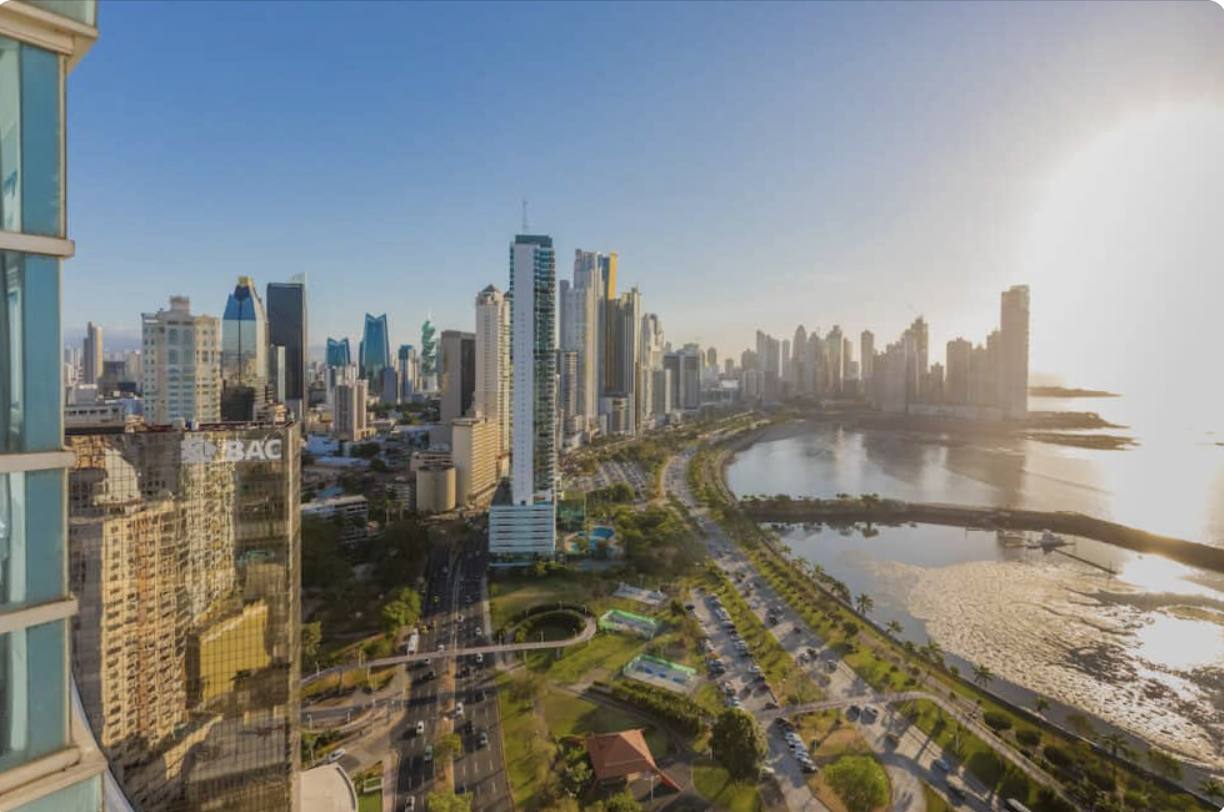
Panama is not a like-for-like replacement for Cayman. It is larger, denser, and more complicated. It is also cheaper across most meaningful categories, significantly more connected to the rest of the world, and — for clients who want actual urban life — a real city rather than a beautiful village with a finance district attached. Both places share the practical advantages that matter to our clients: US dollar economies (Panama has used the USD since 1904; Cayman pegs the KYD to the USD at a fixed rate), reliable infrastructure, safe residential neighborhoods, and private healthcare that meets international standards for most routine and specialist care. Both are outside the primary Atlantic hurricane belt, though Cayman sits closer to the edge of it and has been directly hit (see NOAA climatology data) while Panama has not had a direct hurricane strike in modern record.
What follows is what we actually tell Cayman clients during their first hour with us, condensed into an essay. It is not a sales document. If any of these trade-offs feels like a deal-breaker for you, that is useful information to have before you spend any more time thinking about Panama.
Cost of living: the number nobody gets right on the first call
The honest version is that Panama is meaningfully cheaper than Cayman for almost every line item in a household budget, but the ratio depends heavily on lifestyle. For a family of four living in a good neighborhood and spending as they would in Cayman, the all-in monthly figure is typically 40 to 55% lower in Panama. For a family that fully rewires — shops at local supermarkets, uses public infrastructure, sends children to Panamanian private schools rather than the most expensive international options — the savings can stretch higher. For a family that tries to reproduce Cayman life exactly in Panama, the savings narrow to maybe 25 to 35%.
The largest single line item is nearly always housing. A three-bedroom apartment in Seven Mile Beach or Camana Bay that rents for US$7,000 to US$9,000 per month has a close equivalent in Costa del Este or Punta Pacífica at US$2,500 to US$4,000 per month. You give up the beach access and the smaller community; you gain twice the interior finish for half the rent. Our internal client data on this has been consistent for three years. Independent sources such as Numbeo's Panama City vs. George Town comparison and Mercer's annual cost-of-living survey tell the same story, with Mercer consistently placing George Town in the global top 20 and Panama City outside the top 80.
Groceries are 35 to 50% cheaper. Dining out at comparable-quality restaurants is roughly 40% cheaper. Fuel is materially cheaper because Panama refines regionally. Imported goods — anything branded, anything electronic, anything from Amazon — arrive faster in Panama because of Tocumen's logistics role in the region and are closer to US retail prices. Private school tuition is the exception where the saving is smaller; the very top international schools in Panama (ISP, Metropolitan School of Panama, Balboa Academy) charge fees that are in the same bracket as Cayman Prep or Cayman International, though still generally 10 to 25% lower.
The most common mistake clients make on the first call is underestimating how much of their Cayman spend was in fact a function of Cayman being a small import-dependent island, and assuming that moving anywhere else will be comparably expensive. It is not. Panama is a continental economy with working roads, real supermarkets, and competitive retail.
Healthcare: what changes when specialists stop requiring a flight
In Cayman, Health City Cayman Islands is a serious regional asset and Health Services Authority's Cayman Islands Hospital handles the everyday. But for complex cardiology, advanced oncology, neurology, or anything requiring a large specialist team, Cayman residents have historically flown — to Miami, to Houston, or occasionally to the UK. Flights are short and the system works, but it is a system, and it imposes costs in time, money, and stress.
In Panama City, two hospitals — Hospital Punta Pacífica and Pacífica Salud — are accredited by Joint Commission International, the same body that accredits leading US hospitals. Hospital Punta Pacífica has historically had an affiliation with Johns Hopkins Medicine International. The specialist depth in these institutions is real: cardiology, oncology, orthopedics, neurology, and high-risk obstetrics are all available in-city from credentialed specialists, many of whom trained at US or European teaching hospitals. Our older clients frequently report, once they have established relationships with a cardiologist and a primary care physician in Panama, that this is the first time in years they have not had to think about which country their next medical appointment is in.
There are honest caveats. For the most unusual conditions — certain rare cancers, highly specialized pediatric surgery, experimental treatments — Panama is still a referral jurisdiction to Miami or Houston in the same way Cayman is. And the public health system in Panama, which most of our clients never interact with, is weaker than the private one. If you arrange international health insurance — Bupa Global, Cigna Global, Allianz Care, and ASSA all have strong reputations here — you will almost never encounter the public system.
Schools: the single biggest determinant of when you move
For families with children in school years, the move-or-don't-move conversation is usually decided by the school question before any other. The short version is that Panama City has a mature international school ecosystem with credible IB, American, and British curricula, at fees that are comparable to or lower than Cayman Prep.
The schools our families most often move into: the International School of Panama (ISP) in Cerro Viento, which runs an IB programme and is widely considered the strongest international school in the country; Balboa Academy, an American-curriculum school with an AP programme and a long-established expat community; the Metropolitan School of Panama, newer, IB, strong reputation; Colegio Brader, IB, German-influenced, historically the choice of successful Panamanian families; and Oxford International School in Costa del Este for those who prefer British curriculum and proximity. All have waiting lists for popular year groups. We recommend engaging admissions offices six to nine months ahead of a planned move, particularly for the primary school years.
What you will not find in Panama is an exact replica of Cayman Prep's particular mix of small cohort sizes and heavy individual attention. Panama's international schools are larger, with year groups typically ranging from 60 to 120 students depending on the school and the year. For some families this is an upgrade (more peers, more subject options at secondary level, stronger sports and arts programmes); for others it takes adjustment.
Residency: not simple, but not difficult either
Cayman residents who move to Panama typically pursue one of three visa routes. The Pensionado visa is available to anyone with a qualifying lifetime pension from a recognized source (US$1,000 per month plus US$250 per dependent is the headline figure, though documentation requirements are meaningful). The Friendly Nations Visa is available to professionals and investors from a long list of qualifying countries, including most of those where our clients hold citizenship. The Qualified Investor visa requires a larger investment but offers a faster path and is the route chosen by a meaningful share of our clients who want permanent residency without the constraint of a specific employer or pension source.
In all three cases, the process is handled by a Panamanian immigration lawyer (we work with two firms we trust), requires legalized documents from your country of origin, and takes anywhere from several months to about a year depending on the route and how clean your paperwork is. The authoritative source on the current requirements is the Servicio Nacional de Migración de Panamá. What we add, beyond the legal work, is coordination — making sure your timeline for residency, school admissions, housing, and banking all move in step rather than each one stalling on the others.
Tax: the reason most people start looking, and the reason most people should get independent advice
Cayman has no direct taxation. Panama has a territorial tax system, meaning income earned outside Panama is generally not taxed by Panama. For most of our Cayman clients — whose income is already structured around non-resident status in higher-tax jurisdictions — the practical difference between Cayman's and Panama's tax treatment is smaller than the headlines suggest. The real question is always about your tax residency in your home country, or in any country where you have historical ties or ongoing obligations, and that is a question that requires an actual cross-border tax advisor.
We are not tax advisors. We introduce clients to two independent cross-border tax specialists who can run the specifics of your situation. For general background, the OECD tax centre and the IMF country profile for Panama are reputable starting points. Anyone selling you a definitive tax outcome based on a five-minute conversation about your situation is either reckless or dishonest.
The quieter trade-offs
Beyond the line items, there are quieter things that will shape whether the move actually feels like a good decision eighteen months in.
Cayman is a beach. Panama is a country. Clients often underestimate how much of a psychological shift that is.
You gain scale. In Panama you can drive an hour to a mountain town, or forty-five minutes to a Pacific beach, or take a domestic flight to an indigenous territory on the Caribbean coast. The country has depth. On weekends and in quieter moments this matters more than people expect.
You lose the village. Cayman's best quality, for many of the families who live there, is a certain kind of social density — you see the same people at the same places, your children's friends live up the street, your neighbors become your circle. Panama City, at 1.5 million people, cannot reproduce that density, though specific micro-communities (Costa del Este, Clayton, the expat network around Boquete) do recreate a version of it. This is one of the things we spend real time on during the exploration visit, because it is one of the things clients most often regret not having understood earlier.
You gain professional oxygen. For dual-career families, Panama City has a real professional ecosystem — regional headquarters, legal and financial services, consulting, logistics — that provides genuine career options. Cayman's professional world is narrower and heavily concentrated in a handful of sectors.
You lose the water. This is the thing nobody puts in a brief and half the clients mention six months in. Cayman's relationship with the sea is unusually intimate — the water is clearer, the beaches are closer to where people actually live, and daily life has the ocean in its peripheral vision. Panama City's waterfront is beautiful but the water itself is not swimming water in the city, and the nearest good beaches are thirty to sixty minutes away. Clients from Cayman should plan for this either by setting up a part-time presence on the Pacific coast (Coronado, Punta Barco) or by accepting that the ocean becomes a weekend thing rather than a daily thing.
How to think about the decision
We are biased, obviously. We are not going to pretend otherwise. What we can say is that of the Cayman clients we have worked with in the past three years, a small number decided after their exploration visit that Panama was not for them — and we were glad they figured that out before moving, not after. The ones who have moved and stayed report, when we check in at twelve and twenty-four months, that the biggest positive surprises were the healthcare depth and the amount of actual city life, and the biggest adjustments were the traffic in Panama City and the loss of the village feeling of Cayman.
If you are at the point of seriously considering this, the next step is not another Google rabbit hole. It is a conversation — forty-five minutes, free, with no follow-up unless you ask for one — and if it turns out Panama is not the right call for you, we will tell you so directly.
Sources & further reading
- Numbeo — Panama City vs. George Town cost comparison: numbeo.com
- Mercer Cost of Living Survey — annual rankings: mercer.com
- Joint Commission International — accredited organizations directory: jointcommissioninternational.org
- Servicio Nacional de Migración de Panamá — visa categories: migracion.gob.pa
- IMF country profile — Panama: imf.org/en/Countries/PAN
- World Bank country data — Panama: data.worldbank.org/country/panama
- NOAA National Hurricane Center climatology: nhc.noaa.gov/climo
- OECD tax centre: oecd.org/tax